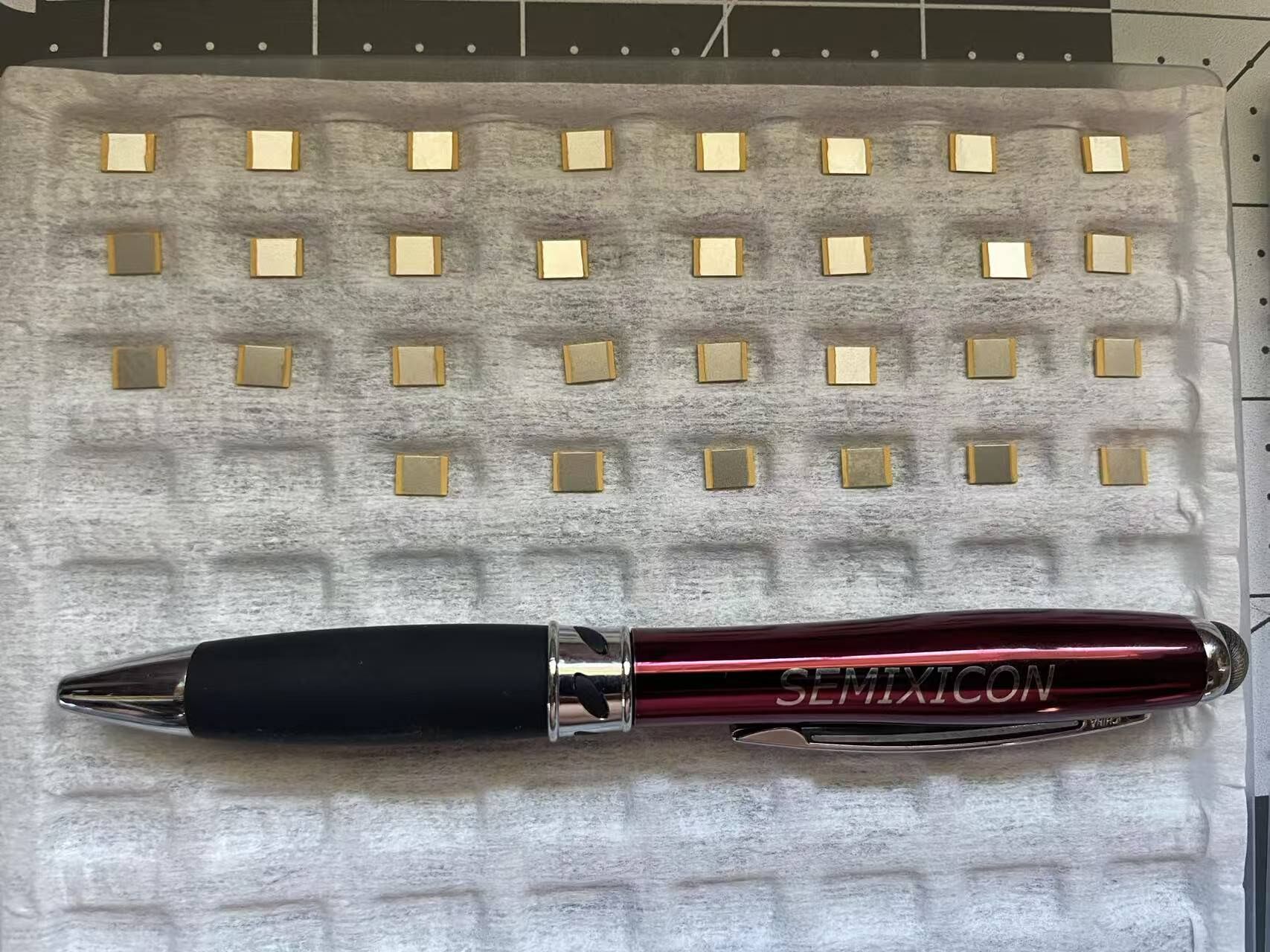
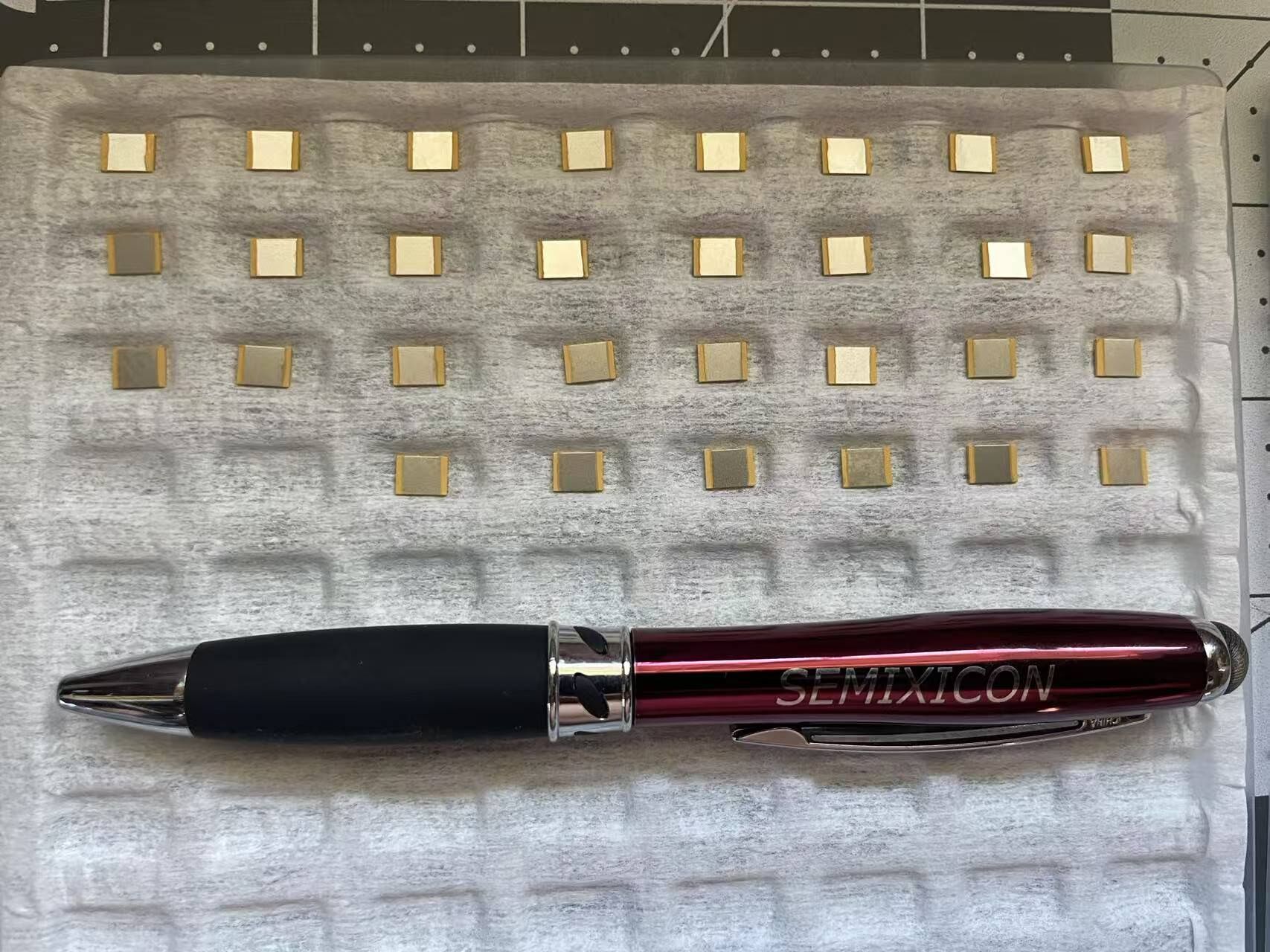
Copper and Diamond Composite Heatsink and Heat Spreader is in great shape !
Copper and Diamond Composite Heatsink and Heat Spreader is in great shape !
Diamond exhibits an exceptional thermal conductivity of 2000–2600 W/m·K, exceeding that of copper (~401 W/m·K) by over 5× and aluminum (200–240 W/m·K) by nearly 10×. This superiority originates from its phonon-dominated heat transport mechanism within a nearly perfect covalent crystal lattice.
Unlike metals such as copper and aluminum, where heat is primarily carried by free electrons and limited by electron scattering, diamond relies on long mean free path phonons. At room temperature, phonon mean free paths in high-quality diamond can reach several hundred nanometers, compared to ~40 nm for electrons in copper. This fundamental difference enables diamond to sustain ultra-high heat flux dissipation with minimal scattering losses.
Under extreme thermal loading—such as localized hotspots in advanced semiconductor devices—diamond enables near-ballistic heat spreading, effectively suppressing thermal gradients and preventing performance throttling.
Thermal Expansion Matching: A Reliability Breakthrough
A critical limitation in conventional thermal management systems is the mismatch in coefficient of thermal expansion (CTE) between materials.
Silicon: ~3 × 10⁻⁶ /K
Copper: ~17 × 10⁻⁶ /K
Diamond: ~1.0–1.5 × 10⁻⁶ /K
This mismatch induces significant thermomechanical stress during temperature cycling, often leading to interface delamination and reliability degradation.
DIASEMI’s diamond–metal composite platform enables precise CTE engineering (6–9 × 10⁻⁶ /K) by tuning diamond loading ratios, achieving an optimal balance between thermal conductivity and mechanical compatibility.
Over typical operating ranges (−40°C to 125°C), conventional copper interfaces can accumulate strains of ~0.14% per 100°C cycle. In contrast, DIASEMI’s composite reduces mismatch-induced strain by more than 50%, extending system lifetime by an order of magnitude.
Interface Engineering: Eliminating the Thermal Bottleneck
In traditional systems, thermal interface materials (TIMs, 1–10 W/m·K) dominate total thermal resistance.
DIASEMI addresses this through atomic-scale interface engineering, reducing interfacial thermal resistance by over 90%.
A proprietary multilayer metallization strategy is applied to diamond particles:
Titanium (5–10 nm): chemical bonding layer
Nickel (20–30 nm): diffusion barrier
Copper (50–100 nm): metallurgical integration
This gradient architecture enables:
Interfacial thermal resistance reduced from ~10⁻⁴ to ~10⁻⁶ m²·K/W
Shear strength exceeding 50 MPa
Long-term stability under extreme thermal cycling
Manufacturing Breakthroughs: Scalable 3D Composite Integration
DIASEMI has developed a scalable manufacturing platform addressing three core challenges:
1. Particle Dispersion
Surface functionalization reduces wetting angle below 30°, enabling uniform dispersion and dense packing with diamond volume fractions up to 60–70%.
2. Densification
Advanced sintering processes enable >98% relative density within minutes, forming robust diamond–metal networks.
3. Surface Engineering
Multilayer metallization ensures strong bonding and stable interfaces across extreme environments.
Performance Validation: High-Performance Computing Deployment
DIASEMI diamond composite thermal modules have been validated in next-generation high-density compute systems, demonstrating:
Up to 80% improvement in heat transfer capability
Junction temperature reduction of 30–50°C
Stable operation at >500 W/cm² heat flux
This enables:
~10% performance uplift in AI workloads
Reduced training time for large-scale models (~10%)
Data center PUE approaching 1.04
High thermal efficiency allows ultra-dense system architectures, increasing rack power density by an order of magnitude while significantly reducing footprint.
Applications: From AI to Extreme Environments
DIASEMI diamond-based thermal solutions are expanding across multiple sectors:
AI & HPC: unlocking sustained peak performance
RF & 6G systems: managing high-frequency thermal loads
Electric vehicles: enabling high-power modules
Consumer electronics: improving performance and battery life
Aerospace: ensuring stability under extreme conditions